An explanation of what’s going on here can be found in the intro post.
Last time, we looked at the Saturn in August 1996 with Olympic Soccer: Atlanta 1996, Alien Trilogy, Alone in the Dark: One-Eyed Jack’s Revenge, and Nights into Dreams.
When we last looked at the Jaguar, we kicked-off 1995 with Syndicate, Troy Aikman NFL Football, Cannon Fodder, Theme Park, and Double Dragon V: The Shadow Falls.
Coming back from an unplanned hiatus, we’re slogging towards the anticipated late-year launch of the Jaguar CD with the dregs that couldn’t make it there. This hodgepodge includes Hover Strike, International Sensible Soccer, Power Drive Rally, Pinball Fantasies, and Super Burnout.
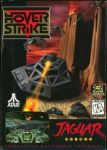
Hover Strike
Developer: Atari Corporation
Publisher: Atari Corporation
Release Date: 4/1/1995
Time to Going Full Speed Into A Wall: 58 Minutes
I was originally going to come in here, describe what this game is, pronounce it to be kinda busted, and move on. That would be easy enough to do, as Hover Strike is a slight, mission-based hover tank game where the tank feels like an air hockey puck. It goes for a gameplay and visual style that evokes, sometimes bordering on litigious, the likes of Stellar 7, Offworld Interceptor, Total Eclipse, and Shock Wave but with the added Amiga-brained twist of your hover tank having conservation of momentum on levels not open enough for that to be fun. Crib from the worst, add an interesting idea, and immediately undercut it, welcome to the early fifth gen. Yet don’t let the name on the box fool you, this thing is was supposed to be Battlezone 2000. Yes, that Battlezone. Also, yes, that 2000.
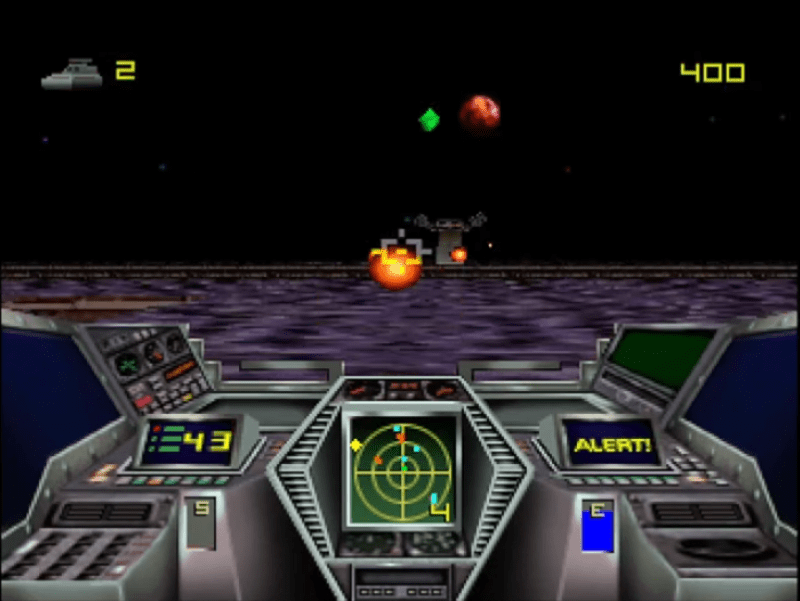
As of writing, our current version of Atari has gained a reputation for rebooting their ancient properties in bizarre ways. Just in 2025 we saw Adventure of Samsara, which is a Soulslike Metroidvania remake of frickin’ Adventure from the 2600. They’ve been doing this stuff on and off for years, and it’s always odd when one of these reboots comes along and is passable. The version of Atari owned by the Tramiels did some of the better updates of the old IPs, with Tempest 2000 being the golden example. And looking at it, if it weren’t for the aggressive collision damage and wonky environments, this could have been good enough to keep that Battlezone branding.
Yet, in practice, this is a dubious physics demo. The game also isn’t helped by all the fiddly controls for the camera and secondary weapons getting relegated to the numpad, which isn’t ideal for an action game. Even with these issues, this is one of the more complete and coherent games yet published for the Jag. I was even able to have some modicum of fun doing thunder runs at mission objectives, because speed is the best armor against enemy fire in a game this squirrelly. Something about the way this game moves makes me think of the Archimedes Acorn for whatever reason, which is likely more an indication of my mental health than anything. Anyway, Hover Strike would be a mid-tier game on the 3DO, but here it’s almost a top 10 experience, motion sickness inducing movement and all.
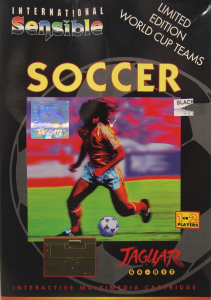
International Sensible Soccer
Developer: Renegade Software
Publisher: Telegames
Release Date: 4/1/1995
Time to Senseless Soccer: 50 Minutes
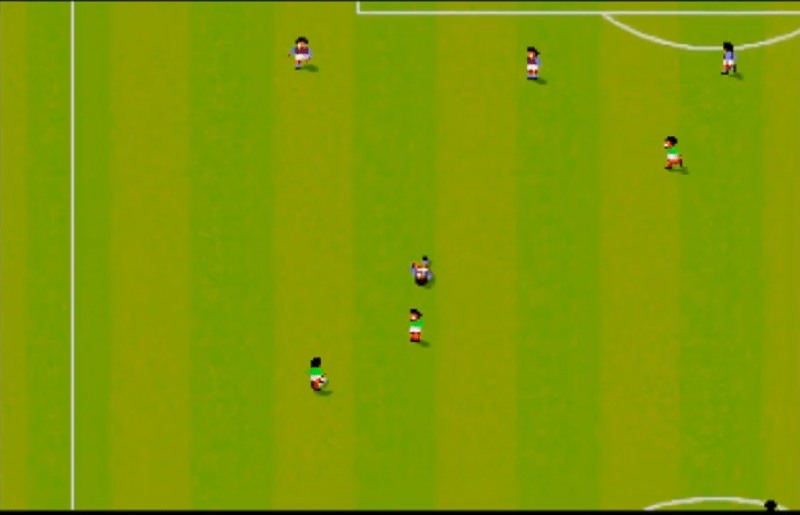
I can’t see the appeal of Sensible Soccer. Those original Amiga games look and feel like fast-moving 8-bit Soccer games. Like, if a Famicom soccer game developer had put all their effort into fast scrolling you could have ended up with Sensible Soccer. In my efforts to grapple with this series, I’ve reached the conclusion that they were probably the best Soccer games developed in PAL regions at the time, but that would still probably place them well behind the 16-bit FIFA and Captain Tsubasa games coming out of the US and Japan. I’ve tried playing Sensible Soccer, and it feels bad, with all of the hallmark issues with sports games of the time on display front and center. On top of that, this specific port of International Sensible Soccer for the Jaguar is a version that fans even probably wouldn’t want to go back to.
I’ve been using the series name and the name of this specific entry interchangeably, so let’s clear that up first. The creatively titled Sensible Soccer: European Champions was released by Sensible Software for the sensible Amiga in 1992. It plays as a riff on the earlier, and less sensible, Kick OFF series of games, which were known for squeezing as much movement speed as possible out of 8-bit systems and not much else. Sensi (os awl me mates cawl it) took that idea and applied Amiga Power™ to it, zooming the camera out as far as possible and having the little blobs of pixel zip around at like 50kph, or roughly 0.5 Doomguy. Sounds like a valid concept for a Soccer game, right until you play it. In practice the speed and tiny everything makes the action squirrely and incoherent while the opposing AI tends to be both hyper aggressive and faster than you. None of that even addresses the automatic player switching or tepid friendly AI problems that were endemic to the genre as a whole, and which are not improved upon here. In short, the game is extremely Amiga.
The original release sold well enough in the UK to inspire Sensible Software to crank out three sequels by the end of ’94, with International Sensible Soccer being a port of the second sequel. Funnily enough, the Sensi game right after that one, Sensible World of Soccer, is the entry in the series that people tend to care about. So, you could say the games didn’t fully come together until that entry, but in practice the differences between releases is minor. From its high point with SWOS, the series rode the Amiga well past the end and didn’t fully jump to Windows or polygonal graphics until ’98, at which point both the franchise and Sensible Software immediately dropped dead. There have been a few revival attempts over the years, but the franchise’s niche audience of British children in the mid-90’s are no longer children and no longer live in the mid-90’s. Even then, nostalgia is a hell of a drug, which is why you tend to see SWOS end up on “top n games of all time” lists whenever there’s a British person in the room.
Personally, I’ve tried looking at this series outside of playing this Jag release, and I don’t get it. The design philosophy looks like a dead end, and nothing important spawned directly from these games. These things aren’t anywhere close to fun in singleplayer, and I don’t have a 10-year-old English boy from 1995 to play multiplayer against, so I’m probably never going to get the appeal. Speaking of this release specifically, for all my physical revulsion at playing International Sensible Soccer, it does seem to run the best out of all the console ports of those early Sensi games, even if you have to use the Jag’s control layout. Anyone going back to this series these days is going to be better off finding a way to play the amiga version over messing with this, so we can move on and hopefully never think about Sensible Software again.
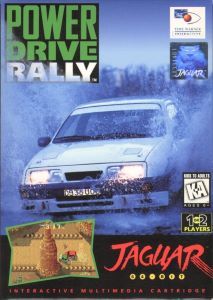
Power Drive Rally
Developer: Rage Software
Publisher: Time Warner Interactive
Release Date: 6/1/1995
Time to Not-So Micro Machines: 40 Minutes
Back in the 80’s, mediocre top-down Racing games were a dime a dozen, but in the 16- and 32-bit eras, scaler and early polygonal Racers dominated. That’s what makes Power Drive Rally kinda special as a swan song to a type of game that would largely only exist on handhelds and phones after this point. Not that this is the final top-down Racing game on consoles, as I’m sure there is at least a handful in the obscure corners of the PAL-only PS1 catalog, but this seems like the last one that would be any kind of significant entry in any console’s library. I’m confident in that last part because every jag game is a significant entry in its catalog.
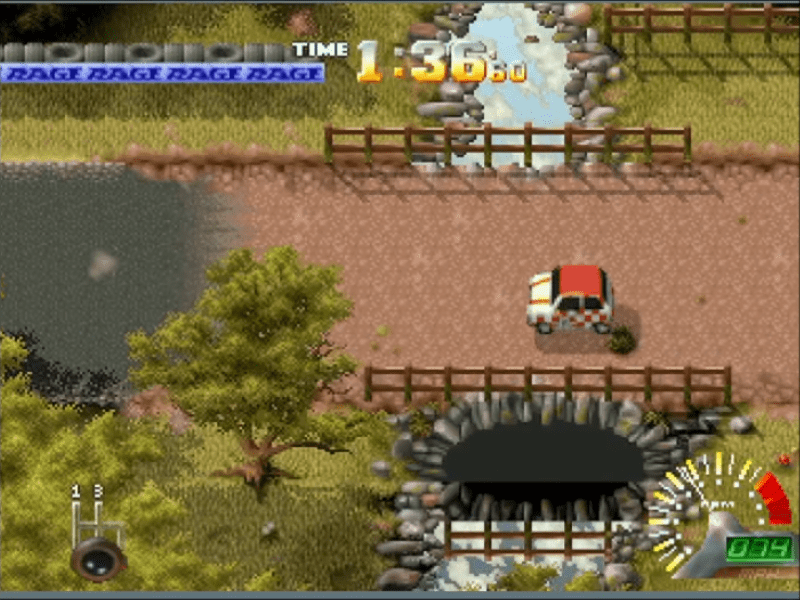
The top-down style of non-sim Racing games was the default until OutRun made its way through international arcades in 1986 and ’87, leading to increased popularity of the more immersive super scaler style. That design language would translate to the early polygonal Racing games of the early 90’s and then to the genre as a whole going into the 3D era. Yet, the old top-down style remained in vogue with British developers right up until the unavoidable polygonal future. Being generous, I attribute that stubbornness to the success of Rare’s RC Pro-Am games in the late 80’s and the years of imitators that followed. I would call those Rare games good, but only narrowly, which means the other developers who missed the subtle design choices which make RC Pro-Am work aren’t going to create the best experiences. Enter Rage Software, makers of the Striker series of Soccer games (a series I would play over Sensible Soccer any day of the week).
Rage’s Power Drive came out in ’94 for the Amiga and 16-bit consoles. It used the standard RC Pro Am mode of gameplay while adding slippery rally physics, weather hazards, and a fairly strict system of budgeting and car management. It looked good enough for an Amiga game, but the little touches that make this type of game enjoyable are missing, such as a minimap, wider view of the track, consistent physics, and AI who are beholden to the same problems as the player. The package comes together somewhat poorly and is best described as mediocre. The thing with Power Drive Rally is that it’s basically just Power Drive again except with 32-bit sprites, dubious rallycross levels, and a bizarre water reflection visual effect that makes it look like you’re driving on an island in the sky. There really isn’t much nice to say about this game, so I’m going to end my description here. Rage would also end it here and not revisit this subgenre again. I’ve never been a fan of this type of Racing game, so I’m somewhat relieved that I won’t have to cover that many of them as part of this project.
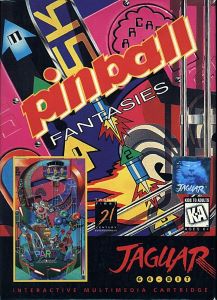
Pinball Fantasies
Developer: Spidersoft
Publisher: 21st Century Entertainment
Release Date: 6/9/1995
Time to Bouncing Back And Forth Forever: 40 Minutes
This one is a port of the 1992 Amiga game of the same name, developed by some Swedes at a studio called Digital Illusions, who would later be best known for developing Midtown Madness 3 for the Xbox. I’m told that both Pinball Fantasies and its immediate predecessor, Pinball Dreams, are credited as the first 32-bit pinball games, and it can be said that all Pinball games on 32-bit systems were just copying its mechanics and format. So, that would explain why all the ones I’ve played so far have kinda blown hot ass.
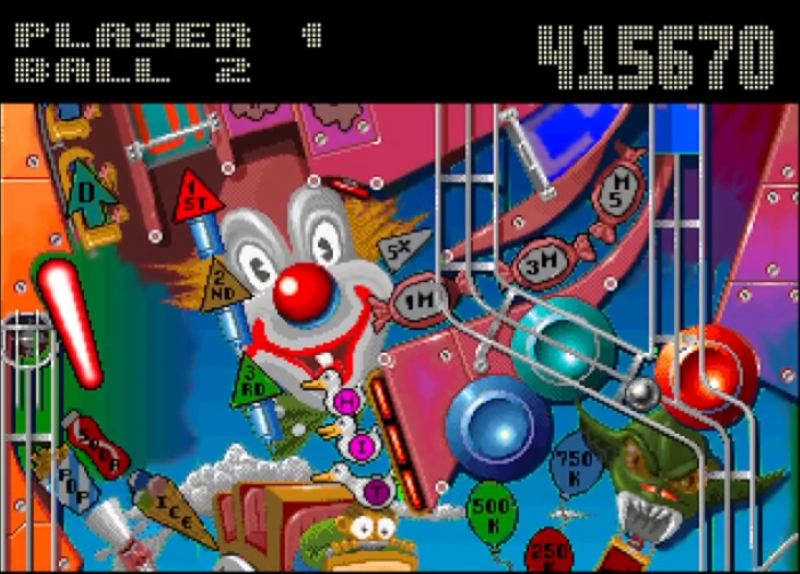
In the three years since its original release, Pinball Fantasies was ported to every conceivable computer, console, and handheld to widely varying results. You could say that this Jaguar port is the most accurate of all the non-PC versions and could have some value in that. That would be, if you were one of weirdos who are inclined towards Pinball video games. Which, look, you aren’t supposed to yuck anyone’s yum in polite conversation, but I’m a disembodied voice on the internet, so I can tell you that this entire genre wasn’t worth anyone’s time or money until like the mid-2010’s, maybe. The thing of it is that the physics in these games was poor until developers figured out how to fully utilize 64-bit processors, and even then, it’s seemingly not that easy to implement. Now, fantastical physics can be forgiven if the game itself takes fantastical leave with the pinball concept, think of Alien Crush as an older example. Yet, at the generational turning point for the genre, Digital Illusions codified the practice of designing realistic pinball boards that would be boring if you encountered them in real life along with not-quite-there realistic physics.
That preamble takes us to this release of Pinball Fantasies, which is exactly what it says it is. The boards are dull, the physics are close enough that it’s uncanny when the ball bounces between the bumpers like 20 times in a row, and the zoomed-in scrolling view hurts playability. This all runs about as well here as it would on an Amiga, which is something. The four boards in the game didn’t leave enough of an impression for me to dig into them, though if I was a fan of Video Pinball as a genre there would be all kinds of things to say comparing the seemingly dull board designs with previous standards and trends in real world design. From what I have seen of that kind of analysis, there is credit to give to the original release, and there’s some credit to give here for the faithful translation, but there’s nowhere near enough fun to be found here for me to be sanguine about it. Now let’s go back dismissing this game’s imitators out of hand.
Super Burnout
Developer: Shen Technologies SARL
Publisher: Atari Corporation
Release Date: 7/5/1995
Time to Barely Hanging On: 55 Minutes
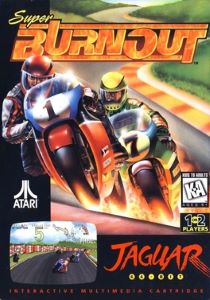
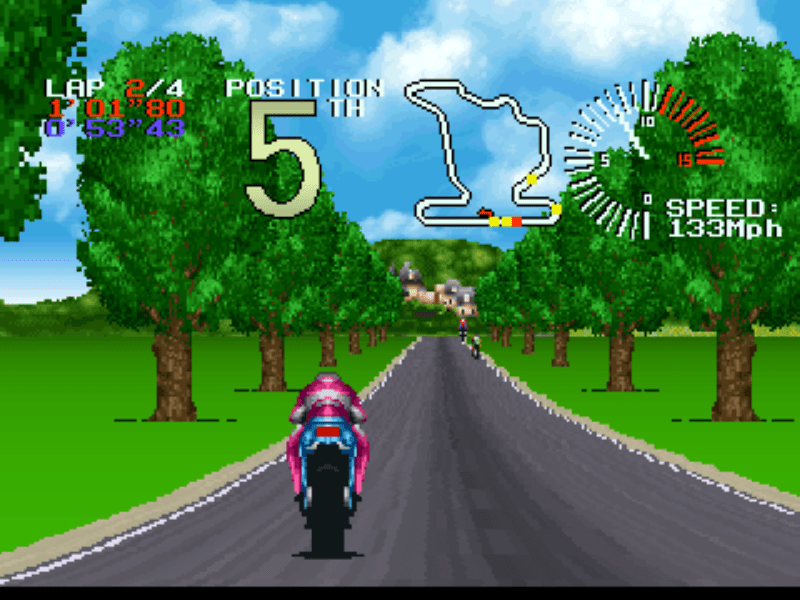
When I got to this point, I was relieved that I finally had a Scaler Racer to latch onto, since I generally like that style of game. I define ‘scaler racer’ as a 2D racing game with a simulated 3D view which either uses or imitates super scaler graphics in the style of OutRun or Hang-On. This is the style which became predominate for Racing games on 16-bit consoles. While Super Burnout has the big sprites and fluid motion you would want from a 2D game on a 32-bit console, the actual gameplay is functionally mediocre and kind of busted.
This is a motorcycle racing game in the vein of Genki’s GP-1 series of SNES racers, and the setup here is pretty basic. There are 8 race circuits based on real, well-known courses and 7 bike options (one of which is unlockable) with unbalanced speed and handling stats to use in standard single-race, championship, and multiplayer modes. When you get into a race, you notice that the sprites are nice an big with the scaled scrolling running at a smooth framerate. When you compare that to something like the Genesis version of Super Hang On, it’s like yeah, Do The Math. Yet, the problems begin immediately upon interacting with it. The vehicle handling is more like a car than a motorcycle, the draw distance is shorter than some braking zones, and the Outrun style auto-steering on wide curves falls somewhere between too aggressive and not aggressive enough. Also, as you play it you notice that there’s visually not much to the tracks, even by the standards of 1995. If this were a late era SNES Racing games, this would barely qualify as a B-tier release. Even in comparison to late 80’s arcade games, Super Burnout wouldn’t have exactly set the world on fire. The more I think about it, the less I would rate it against ’94’s Checkered Flag, which also isn’t a great game. Having this be the Jag’s big racing title of ’95 to go up against Daytona USA and Ridge Racer counts as ritual sacrifice.
To an extent, ragging on this game eventually turns into an exercise in puppy kicking given its development history. I’ve joked before that a lot of Jaguar games were slapdash affairs programmed by like three guys in someone’s garage. In the case of Super Burnout, there were actually five guys in someone’s bedroom. Apparently, the young developers comprising Shen Technologies were originally a French demoscene collective who wanted to make a Hang On fan game and pitched it to Atari because they were already using Atari STs and correctly identified that the Jaguar didn’t have a good racing game. I’m as new to the concept of the European demoscene as you probably are, so a decent way to think about it is like the video game part of Japan’s famous doujin scene, but continental European. I should also note that whatever you do, don’t tell the Academie Francaise that the French word for Doujinshi is Doujinshi.
So, this game was a result of Atari being the most desperate for anyone to put software on their system, and of small-time developers, who were basically students, shooting their shot to get published on a console. The game itself plays like a student project, which would be fine if It wasn’t sold as a full product. This is still close enough to a feel-good story, right up until you find out that this team would go on to make the sequels to Adidas Power Soccer on the PS1, which was the worst Soccer series of the generation.
We’re almost halfway done with the Jaguar library, and I wasn’t expecting this batch of middling European games to be the thing to almost break this project. But I’m still here, and I’m going to push through until I one day reach the promised land of B-tier late 90’s platformers. Let’s update the Ranking of all Jaguar Games and get out of here.
1. Wolfenstein 3D
…
11. Hover Strike
13. Power Drive Rally
14. Pinball Fantasies
16. Super Burnout
21. International Sensible Soccer
…
27. Bubsy in Fractured Furry Tales
We’re almost halfway done with the Jaguar, and I’ve made the executive decision that we’re going to stick with it in a straight shot to the end in order to get this system out of the way. It’s going to be a battle of wills between me and Europe as we look at the last batch of pre-CD releases in 1995: White Men Can’t Jump, Flashback: The Quest for Identity, FlipOut!, Ultra Vortek, and Rayman.
I was featured in Typebar magazine during the hiatus, with an article about the history of digital distribution.
Also, I’m on Bluesky now for reasons of self-aggrandizement, though I need to post more often.
I also sometimes appear over on the Deep Listens podcast network. Be sure to check out their podcasts about (supposedly) obscure RPGs, real video games, anime I’ve never seen, scenic British Columbia, and sports!
You can watch a, by now old, stream archive featuring these games below.
 Fifth Generation Gaming
Leave a comment