An explanation of what’s going on here can be found in the intro post.
Last time, we drove through the middle of 1995 with Hover Strike, International Sensible Soccer, Power Drive Rally, Pinball Fantasies, and Super Burnout.
Now, we’re getting through our last batch of games before the launch of the fabled Jaguar CD add-on. That means we’re going through White Men Can’t Jump, Flashback: The Quest for Identity, Flipout!, Ultra Vortek, and Rayman.
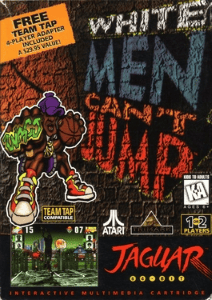
White Men Can’t Jump
Developer: High Voltage Software
Publisher: Atari Corporation
Release Date: 8/1/1995
Time to Bricking It: 45 Minutes
Where to even start with this one. Ok, so, the movie White Men Can’t Jump (starring Woody Harrelson, Wesley Snipes, and Rosie Perez with writing and direction from the guy who made Bull Durham) came out in the Spring of 1992 to decent reviews and reasonable financial success. Broadly speaking, it’s about two street basketball hustlers, the put-upon women in their lives, and hijinks related to both basketball and hustling. People seem to have pegged it as either a foul-mouthed sports movie or a buddy dramedy between Harrelson and Snipes. It’s both, and still mostly works due to the chemistry between the lead performers and snappy dialogue from the era before the Mamat-esque style had devolved into Sorkin- or Whedon-esque banter. Though, while the cheesy early 90’s fashion and lingo has aged into endearing kitsch, the race relations at the heart of the premise has moved into the realm of what-the-hell-are-you-even-talking-about. It seems like it would be the kind of movie that should fade into the background as a partially remembered 90’s crowd pleaser. Yet, somehow, there was a full on remake released for Hulu in 2023. That version gained no traction, and I don’t want to talk about it because doing so would involve acknowledging Jack Harlow’s acting career.
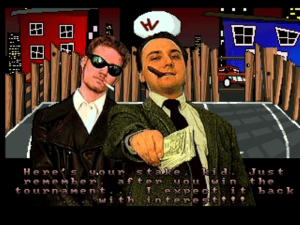
In 1993, through a convoluted business arrangement, the newly formed High Voltage Software, who I personally remember from The Conduit, was given the White Men Can’t Jump license for their first game. For whatever reason, the license was for the name and branding and not anyone or anything from the movie, so what we end up with is a store brand take on the core premise. This is a 2-on-2 Basketball game where you play on a half court with some street rules added in, such as taking the ball out to half court when you get it. It comes with the expected single game, campaign, and multiplayer modes but with the added twist of the multiplayer supporting four players through a multitap accessory. The campaign is the only place in the game to even obliquely gesture at the movie, with the setup being that you owe money to loan sharks and have to bet cash on b-ball games. In practice you progress up a loose ladder of opponents offering increasing amounts of money until you eventually get enough to enter a tournament, which is just a more strict ladder. The thing making this mode more than just an arcade difficulty ramp is that your money pool allows you to continue on if you lose a game here or there, with it only failing you out if you go below zero. There are SNES sports games with more going on than this thing, but that’s not the bad part.
The thing is, the act of playing basketball in White Men Can’t Jump is horrendous. I came into this batch of games with the goal of being more generous in my write-ups, but even contemporary reviewers were windmill dunking on this thing. The camera is placed looking in from half-court on the crude 3D playfields, and slightly follows the action in and out with the players displayed as sprites with dubious hitboxes; a combination that makes parsing depth a losing effort. Mercifully, the game only really uses the three face buttons on the Jag with one each for pass/punch, shoot/jump, and sprint. That’s right, this is combat basketball. There’s a whole anger/stamina mechanic that is supposed to gate how much you can abuse the punching and running, but the impact is marginal. This means when you have the ball, you run around until you shoot or get knocked down, and when the other team has the ball you run up and deck ’em. So, it looks like a confused mess, where you don’t have a good way of knowing what’s happening, only that you must kill.
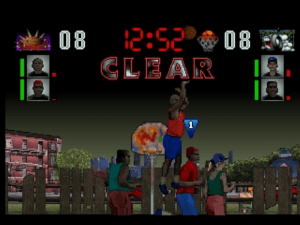
Those issues would make this game subpar, but the real kicker is that shooting seemingly works off of AD&D armor class dice rolls. When you shoot through clear air, no matter where you are or what your meters are at, you’re going to have like a 20% chance of making the basket. It all feels random except for the fact that the AI seems to sink their balls something like 25 – 40% of the time, depending on difficulty. The gods of streetball have stacked the deck against you, which means you need to play aggressively and precisely in order to win, but that’s gunked up by the visual chaos onscreen. It doesn’t help that the pass button requires a hold instead of tap and just doesn’t work most of the time, which is exacerbated by the teammate AI being dumb as a sack of bricks. The funniest part is that there’s supposed to be a NBA Jam inspired power dunk animation that can be triggered from anywhere on the court given certain arcane conditions, but it’s blockable. That means most the time when you or the opposing AI begin the animation the player doing it gets immediately punched out of the air. There are a hundred other small things, from the graphics to the animations to the sound design that just do not work, which add up to the game being physically unpleasant to interact with for any amount of time. Even though it’s the only Basketball game so far for the Jaguar, I still wouldn’t call it the best because an absence would be preferrable.
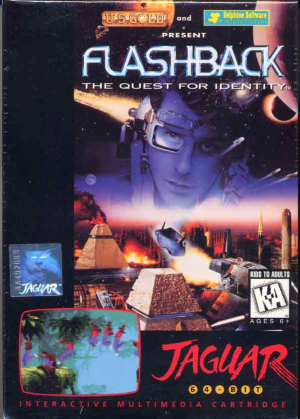
Flashback: The Quest for Identity
Developer: Tiertex Design Studio
Publisher: U.S Gold
Release Date: 8/9/1995
Time to Instantly Vaporized: 30 Minutes
It’s been a couple of years since we saw Flashback on the 3DO. In the time since I’ve come to accept that the name for its genre is Cinematic Platformer, and that all the entries in that niche are purposefully clunky in homage to 1989’s Prince of Persia. Yet, I’m still of the opinion that Another World has enough interesting artistic intent to make it one of the three worthwhile entries in that genre, along that original Prince of Persia and the much later Oddworld: Abe’s Odyssey.
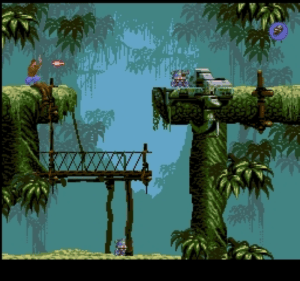
To reiterate, Flashback is the game made by Delphine Software in order to cash in on the critical and commercial success of Another World, which, while largely developed by Eric Chahi on his own, wound up with Delphine in order to get it out the door. Chahi took off after his project released at the end of 1991, but the studio seemingly had his consent in making their own follow up to his game so that they could strike while the iron was hot. Thus, Flashback: The Quest for Identity made it to store shelves before the end of ’92. Through their efforts, Delphine made Flashback such that it roughly looks like Another World, sounds like Another World, and quacks like Another World, yet it is a fundamentally different thing in practice. The framing, rhythm, atmosphere, and overall artistic intent of that original game are nowhere to be found here. This is a normal Amiga Action Platformer built on the bones of the second noteworthy Cinematic Platformer ever made.
There’s awkward running, finicky jumping, even more awkward shooting, and item based puzzles where the difficulty is in avoiding instant-death hazards. Like it’s forebearer, there’s no screen scrolling, but where that limitation was previously worked around, here the levels are designed like a typical multi-tier Genesis platformer. This leads to awkward transitions that can leave you vulnerable to those quick deaths or other annoying failure states. In terms of the overall game, Flashback has a similar area progression to Another World, going from alien wilderness to alien city to alien control center with a simple plot, which I’m going to be generous and not interrogate because if I did I would end up ranking this thing below Bubsy.
Flipout!
Developer: Gorilla Systems
Publisher: Atari Corporation
Release Date: 8/28/1995
Time to Cheesing Out: 40 Minutes
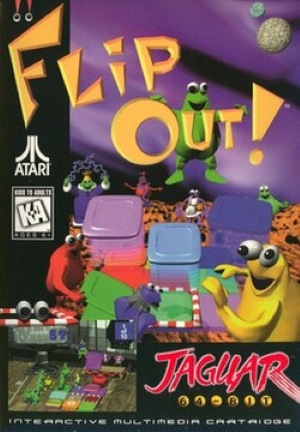
I have been so used and abused by these Amiga ports that two minutes after I started playing this I said, “look at this Amiga bullshit.” Yet, this isn’t a port of any kind; Flipout! is a Jaguar original developed by a random handful of guys in Florida, of all places. So, there isn’t much excuse for the weird pre-rendered graphics or cheesy sensibilities. Even still, it’s refreshing to have an honest-to-goodness Jaguar game to finally dig into.
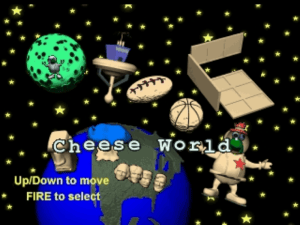
At its core, Flipout! Is a tile matching Puzzle game. You’re given an isometric 3×3 grid of colored objects, let’s call them panels, with a second layer of colored objects on top, which I’ll call tiles. The placement of the tiles doesn’t match the pattern of the panels and you have to sort the tiles to match. The trick is that you interact with the tiles by flipping them in the air and selecting the spot where they land, which in turn flips the tile in that spot into the air. If a tile lands on the ground without you selecting a panel, it’s game over. That results in a pretty simple plate spinning game where you can wind up brute forcing the solutions, which is where the premise comes in. You’re apparently taking part in some kind of tile flipping tournament on the cheese planet and the onlooking crowd of weird little Gumby alien guys get so excited that they run on the playfield at random intervals and cause various effects. Hopefully that last sentence clues you in on why I thought this was an Amiga game. These random little freaks add enough chaos to the plate-spinning that the game keeps you sufficiently on your toes, though I don’t know if I would call that fun. I could summarize the basic gameplay loop as a Zoop-era, Q-bert-esque take on Klax if I wanted to be obnoxious about it.
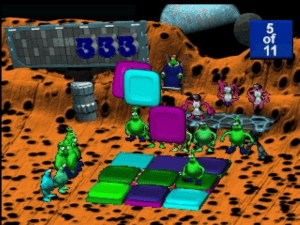
There are stages of various sizes across the game, with each one after the first messing with the playfield, physics, tiles, or types of little guys; all of which culminates in a final boss on a 4×4 grid. Though, to get to that final boss you have to get past the second-to-last stage with a three-dimensional play field where there are two half grids arranged vertically on two sides of the main grid,, and it’s likely this stage that breaks most people. It really does seem like the guys at Gorilla Systems took the base puzzle concept and did everything possible with it. The novelty and completeness of this package on its own would make it one of the best Jaguar games, but there’s a catch: the game isn’t fun. Now, I know that fun is in the eye of the beholder, but the vast majority of people who have ever picked this game up for more than ten minutes have likely found it to be kind of a pain in the ass. The main culprit is the d-pad movement for selecting tiles, the speed and precision with which you can get around the board is poor enough that I was convinced this was originally a mouse-based game, which would have made so much more sense.
The game did eventually get ported to DOS, but it made no impact there either. I feel somewhat conflicted about this one, since there is enough originality, effort, and follow-through in Flipout! to be a hidden gem for the Jag, but the fatal flaw in the controls is baked in at such a fundamental level that it’s never really been recommendable. This concept could have been made as just the first world by one person in flash less than ten years later and it would have had just as much, if not slightly more of an impact on the wider world. As far as Jaguar games go, this one is at least worth looking up a longplay.
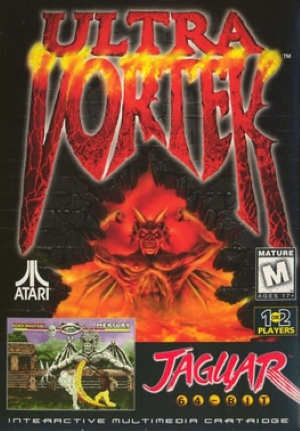
Ultra Vortek
Developer: Beyond Games
Publisher: Atari Corporation
Release Date: 9/13/1995
Time to ANNIHILATION TIME: 45 Minutes
I came into this expecting to rip and tear a new hole in another offensively awful Mortal Kombat clone. I vaguely remembered seeing Ultra Vortek on lists of bad Fighting games, and given everything else we’ve seen from Fighting games on the Jag and 3DO, I was ready to vent some deep-seated frustration at this one. Alas, we might have just stumbled upon the best Fighting game in the Jaguar catalog.
Now, I’m not saying this is some lost classic. What we have here is a rote MK-clone that no one rightfully cared about in the era or since. Starting from the top, Ultra Vortek is a 2D Fighting game using digitized sprites, basic combos, and “Annihilation” finishing moves. The whole thing looks, sounds, and moves like a juiceless MKII, with the main differentiator being (relatively) high fidelity stage animations and the way one of the fighters turns into liquid to move around. Speaking of this cast of weirdos, you have white guy, black guy, blonde woman, stunt coordinator in a robot suit, and three stop motion models (four, if you count the final boss), including a freaky robot skeleton, Elon Musk’s rocksona, and the aforementioned guy made of liquid. You’ll notice that count only goes to seven, which is less than the standard eight characters new Fighting games are supposed to have in this era. Still, the digitized sprites are done well enough and this game is probably the least racist MK-clone we’ve seen outside of Primal Rage.
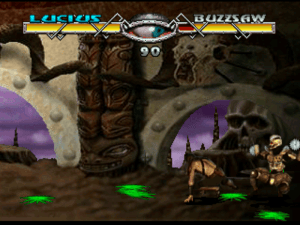
The fighting itself is about as inoffensive as these things get, and I’m really struggling to find anything else to say. I’m not one of these kinds of guys, so I can only really evaluate general feel, difficulty levels of the ladder mode, and basic combos. In this case, it feels like one of these, has an appropriately wide difficulty range, and these combos sure are off-brand MK moves. Like other games of the time, the modes include a singleplayer ladder, two-player, and a training mode. There’s nothing missing, other than a fighter, and nothing particularly wrong with what’s going on here, but also nothing particularly right. The one thing that did stand out to me is the frickin’ novella in the game manual laying out the overly elaborate urban-fantasy setting involving an ancient Incan tablet, multiple apocalypses, cyborgs, Squeebs, and transnational street gangs. There’s full breakdowns for all the various factions and bios for each character. It’s nuts and I appreciate the superfluous effort.
If this had been a launch window game for the PS1 or Saturn it probably would have sold like 20x as many copies while being just as forgotten in the end. If you play any game from this batch, go for Flipout!; if you play any other game from this batch you might as well try Ultra Vortek, the best Fighting game on the Jaguar.
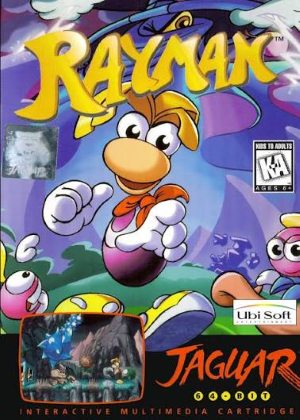
Rayman
Developer: Ubisoft
Publisher: Ubisoft
Release Date: 9/19/1995
Time to I Refuse To Play This Again: 20 Minutes
I chose to look into the Jaguar catalog even though I knew this day would come. We all must eventually reckon with our past selves, and now I have to go back and reference some of the cringiest early writing I produced on this journey. For as painful as that is, at least I don’t have to re-evaluate my feelings on the original Rayman, because this game still sucks.
That doesn’t mean my analysis is the same, with time and experience I’ve learned to identify what’s going on here. This is a Platformer that descends directly from the conventions seen on European computers, in a subgenre that I call Amiga Style Sidescroller. I CALL IT THAT BECAUSE THESE GAMES ARE ASS…deep breath. So, Rayman is a game where you jump between platforms, at first to the right and up but eventually in nonsensical maze patterns, collecting brightly colored round things and punching the main collectables. That punch can also be charged and used against enemies to varying effect with some French ideas about hitboxes. The jumping doesn’t feel great, and the levels stink. Aside from aggressive enemy respawns, janky physics, convoluted level design, and bad autoscrolling sections, you also have some poorly considered placement of foreground elements, gaudy use of colors, obnoxious enemy behaviors, and a laundry list of other annoyances pervading every second of this game. Yet, as much as I hate to type this, Rayman is the best Platformer we’ve seen on the Jaguar.
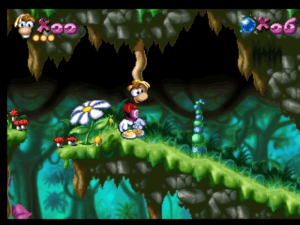
A lot of the problems here pervade the ASS genre as a whole. The other platformers we’ve seen on the Jaguar, Zool 2 and Bubsy, and even Soccer Kid on the 3DO, demonstrate nowhere close to the artistry and development skill seen here. By those standards, Rayman looks and sounds great, has clever design elements, and feels better than its ASS peers. What seem to a casual observer to be tacky art and a weird soundtrack are noteworthy achievements for a new European studio at this time. Even widening our scope to include American development, Rayman is significantly less cringe than something like Earthworm Jim 2. As a last note, you might be wondering about the Donkey Kong Country games, and while that is outside the scope of this project I’ll just say those aren’t particularly ASS and are far superior in their entireties to even the best parts of Rayman.
Oh, and the Jaguar port feels fine. It’s closer to the 16-bit versions in terms of features while presenting at the fidelity of the 32-bit versions, and considering the quality of the voice acting they put on those CDs I would say this is an improvement to the 32-bit releases via exclusion.
With that, we’re now over halfway through the Jaguar library. I can see the end off in the distance, and I want to reach it just to say that I completed one of these consoles. Let’s update the Ranking of all Jaguar Games and get out of here.
1. Wolfenstein 3D
…
14. Flipout!
17. Ultra Vortek
22. Rayman
25. Flashback: The Quest for Identity
29. White Men Can’t Jump
…
32. Bubsy in Fractured Furry Tales
Next time, we’re going to cover the launch of the Jaguar CD and the games going to the end of October ’95, which are Blue Lightning, Vid Grid, Pitfall: The Mayan Adventure, Hover Strike: Unconquered Lands, and Highlander: Last of the Macleods. There are some real doozies coming up, so make sure to check in to see what’s in store.
I was featured again in Typebar magazine since the last post, this time writing about a forgotten gem from the PS2 launch.
I also sometimes appear over on the Deep Listens podcast network. Be sure to check out their podcasts about (supposedly) obscure RPGs, real video games, anime I’ve never seen, scenic British Columbia, and sports!


Leave a Reply